The Complete D365 F&O Security Governance Engagement — What It Covers and Why It Matters
Most D365 implementations go live with security debt nobody addresses until an auditor finds it. Discover the complete seven phase security governance engagement framework and what your organization receives at the end.


Most Dynamics 365 Finance and Operations implementations cross the go-live finish line carrying a massive, invisible liability: security debt.
During the sprint to launch, functional delivery always takes priority over granular access control. System integrators assign standard, out-of-the-box roles just to bypass workflow errors and get the business moving. The result is an over-privileged environment that sits quietly until an external auditor uncovers a catastrophic control failure, or Microsoft enforces a license true-up that triggers a six-figure unexpected bill.
Fixing this requires more than just unassigning a few roles. It requires a complete D365 F&O security governance engagement to transition the system from a compromised state into a fully secured, audit-ready framework.
The Post-Go-Live Reality: Why Security Breaks Down Once a system goes live, the security model immediately begins to decay through a process called security drift.
Employees change departments, earn promotions, and absorb interim duties. They acquire new system access to perform these new jobs, but their legacy access is rarely revoked. At the same time, business processes evolve, and custom code introduces new menus and tables that are never properly mapped to security objects.
Because the business process itself does not break, IT teams often deprioritize security maintenance. This unchecked drift inevitably leads to severe D365 SoD remediation challenges, unmitigated fraud risks, and expensive D365 license optimization failures as users quietly creep into Enterprise-level licensing tiers.
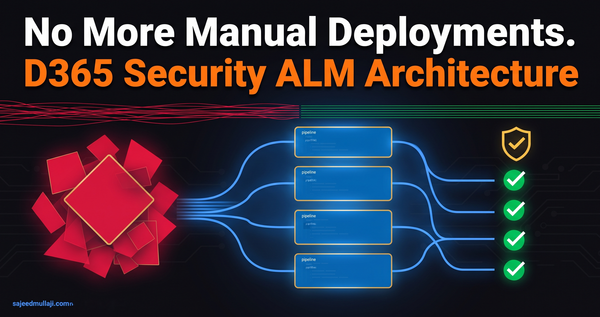
The Seven Phases of a Complete Engagement A world-class governance engagement does not rely on guesswork or trial and error. It follows a strict, sequential seven-phase methodology executed natively within the ERP.
Phase 1: Discovery and Baseline You cannot secure what you cannot see. The engagement begins by extracting the exact, current state of the system directly from D365. This exposes active users, identifies inactive accounts, locates orphaned roles, and highlights System Administrator sprawl—particularly integration accounts that were improperly granted global admin rights.
Phase 2: Segregation of Duties (SoD) Analysis The baseline data is pushed through a strict SoD ruleset. This phase detects the toxic combinations of access currently hiding in the system. If a single user has the systemic ability to create a fictitious vendor and authorize a payment to that vendor without oversight, this phase flags the exposure so it can be neutralized.
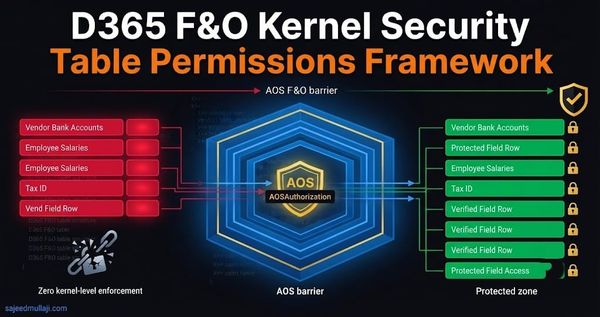
Phase 3: D365 Role Engineering Standard D365 roles are notoriously bloated, granting far more access than a user requires. This phase breaks down the existing architecture and executes bottom-up role engineering. Security is rebuilt strictly on the principle of least privilege, ensuring users have exactly what they need to execute their tasks, and absolutely nothing more.
Phase 4: License Optimization Security dictates licensing. By stripping away unnecessary privileges during the role engineering phase, the system naturally downgrades user license requirements. This phase calculates the precise financial impact of the new security model, harvesting real cash savings by moving users from expensive Enterprise tiers down to Team Member or Activity tiers.
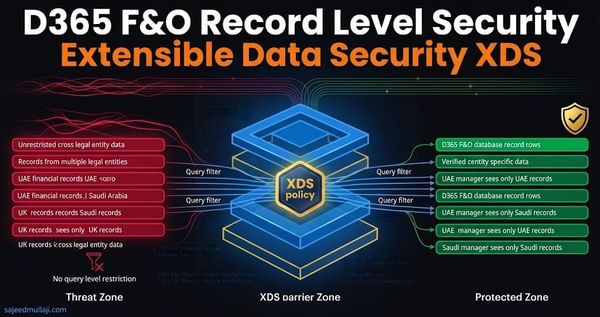
Phase 5: Extensible Data Security (XDS) Standard role-based security dictates what menus and screens a user can access. D365 XDS dictates which specific rows of data they can see once they get there—such as restricting a regional manager to only view financial transactions for their assigned legal entity. A critical step in this phase is accounting for technical bypasses; Extensible Data Security policies are inherently bypassed by OData endpoints and Data Entities. A complete architecture secures both the front-end user interface and the back-end extraction routes.
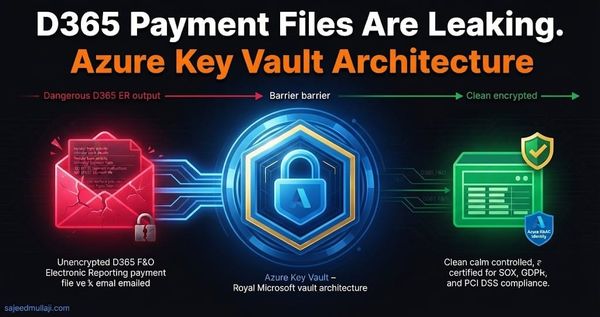
Phase 6: Entra ID Governance Internal D365 security is meaningless if the perimeter is compromised. This phase bridges the gap between the ERP and Microsoft Entra ID (formerly Azure AD). It ensures that multi-factor authentication, conditional access policies, and automated provisioning workflows are tightly integrated with the financial system.
Phase 7: Audit Evidence Delivery The final phase translates technical execution into absolute business proof. It is not enough to be secure; you must be able to prove it to external regulators seamlessly.
The Deliverables: Hard Proof for the Business At the end of a governance engagement, leadership does not receive theoretical advice. They receive measurable, defensible outputs.
The client receives a tested, least-privilege role matrix mapped directly to active users. They receive a certified SoD mitigation log detailing exactly how financial conflicts were resolved. They are handed a license optimization report proving hard cost reductions for the balance sheet. Most importantly, the engagement delivers a comprehensive D365 ITGC audit readiness package, ready to be handed directly to external auditors to prove absolute systemic control.
Security is not an IT problem; it is a financial exposure. To protect the balance sheet and establish an unshakeable governance framework, visit sajeedmullaji.com.
Q: What is the most common finding during the Discovery and Baseline phase?
A: The most frequent and dangerous finding is System Administrator sprawl, specifically assigning global admin rights to third-party integration accounts (like a CRM or payroll API). This violates least privilege and creates a massive, unmonitored backdoor into the financial system.
Q: How does role engineering directly impact our Microsoft licensing costs?
A: Microsoft assigns license tiers based on the highest level of privilege attached to a user's role. If an out-of-the-box role grants a user access to a single Enterprise-level menu item they never actually use, you still pay the Enterprise price; engineering custom, least-privilege roles surgically removes those triggers, instantly downgrading the license requirement.
Q: Why do we need an external SoD mitigation log if our system is newly implemented?
A: During implementation, teams often grant sweeping access to bypass workflow errors and guarantee a successful go-live, creating immediate Segregation of Duties conflicts. An external mitigation log proves to your auditors that you have identified these post-go-live conflicts and applied systemic restrictions to prevent financial fraud.